Sex Offender Registration in Victoria
What is the Sex Offenders Registration Act?
If you are convicted of certain sexual offences in Victoria, you may be required to register on the sex offenders register. This is governed by the Sex Offenders Registration Act 2004 (Vic) (SORA). Registration is a serious consequence that can follow you for years — or for the rest of your life. At Angus Cameron and Partners, our criminal defence lawyers have extensive experience advising clients on registration obligations and challenging registration orders where possible.
Who is required to register?
You become a registrable offender if you are sentenced for a registrable offence. 'Sentenced' has a broad meaning under SORA and includes not just standard sentences, but also supervision orders and certain orders made under mental impairment legislation.
There are two categories of registrable offences: mandatory and discretionary.

Mandatory registration
Mandatory registration applies automatically — the court has no discretion. It applies in two situations:
- Class 1 or Class 2 offences committed as an adult. These are the most serious sexual offences listed in the schedules to the Act (see below for an overview of what they include).
- Serious sex offenders under the Serious Offenders Act 2018. If an offender receives a custodial sentence for a serious sex offence and is already subject to a supervision or detention order, the court must make a registration order.
Discretionary registration
For offences that do not fall within Class 1 or Class 2 — and for any sexual offence committed as a child — the court has a discretion to order registration. This means registration is not automatic, and you have the opportunity to oppose it.
The court may only make a discretionary registration order if it is satisfied beyond reasonable doubt that you pose a real risk to the sexual safety of one or more persons or of the community. This is a high threshold, and the assessment focuses on your risk at the time of sentencing — not a theoretical future risk.
The court must then weigh that risk against the significant restrictions that registration would impose on your freedom and daily life. Even if some risk is found to exist, the court may decide that registration is not warranted in all the circumstances.
Classes of registrable offences
SORA divides registrable offences into four classes. The class of offence affects how long your reporting obligations last.

Class 1 offences
Class 1 offences are the most serious and involve penetrative sexual offences committed as an adult against a child under 18. Examples include sexual penetration of a child under 12 or 16, aggravated sexual servitude, facilitating a sexual offence against a child, and certain Commonwealth child sex offences committed outside Australia. Attempts, conspiracy and incitement to commit these offences are also Class 1.
Class 2 offences
Class 2 offences involve non-penetrative sexual offences committed as an adult against a child under 18. Examples include sexual assault of a child, grooming, child abuse material offences, certain cognitive impairment offences, and child sex work offences. Attempts, conspiracy and incitement to commit these offences are also Class 2.
Class 3 and Class 4 offences
Class 3 and Class 4 offences involve penetrative and non-penetrative sexual offences against adults, respectively, committed by a person who is already classified as a serious sexual offender. These classes can trigger discretionary registration.

How long does registration last?
A SORA registration order lasts for life, but the reporting obligations — the practical requirements you must comply with — vary in duration depending on the nature and number of your offences. The table below sets out the reporting periods under section 34 of the Act.
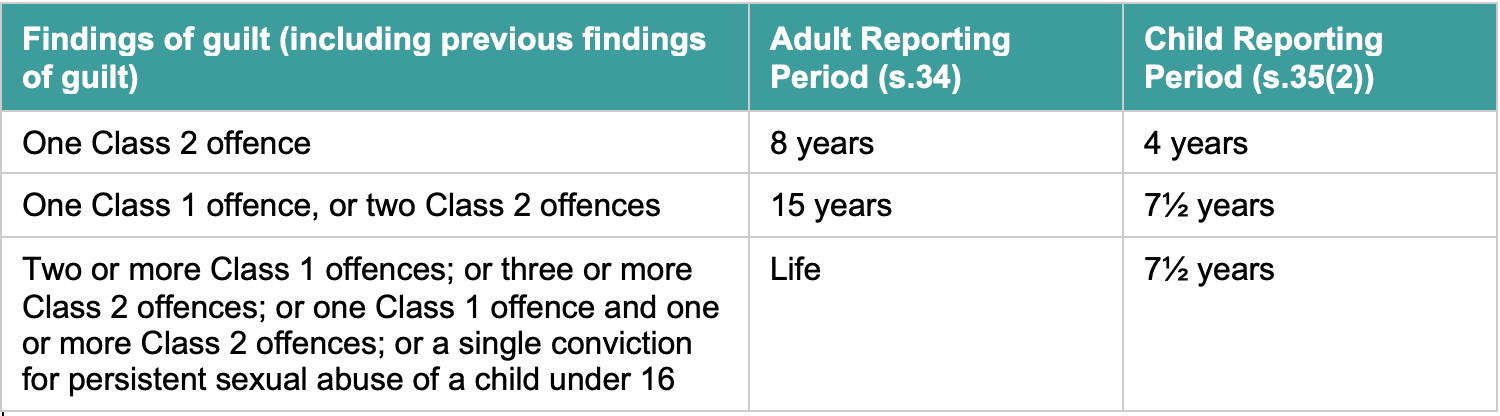
Note: If a registration order is made under the Serious Offenders Act, the reporting period is at least 15 years, regardless of the table above.
How previous offences affect your reporting period
When calculating your reporting period, the court must take into account all previous findings of guilt for registrable offences, not just the offences currently before the court. This means a prior conviction can push you into a longer reporting category.
Multiple offences from the same incident
If two or more offences arose from the same incident — meaning they were committed within a 24-hour period against the same person — they are treated as a single offence for reporting period purposes. A 'course of conduct' charge, which bundles multiple incidents into a single charge, is also counted as one finding of guilt.
Reporting obligations while on parole
If your reporting period would otherwise end while you are still on parole, your reporting obligations continue until the end of your full term of imprisonment. This prevents a gap between parole supervision and registration requirements.
FAQs
Do I automatically go on the sex offenders register if I am convicted of a sex offence?
Not necessarily. Whether registration is automatic depends on the class of offence and whether you were an adult or a child when the offence was committed. Mandatory registration applies to Class 1 and Class 2 offences committed as an adult. For other offences, the court has a discretion and must be satisfied beyond reasonable doubt that you pose a real risk to sexual safety before it can order registration.
Can I challenge a registration order?
Yes. If the prosecution is seeking a discretionary registration order, you have the right to oppose it. Your lawyers can make submissions about the risk assessment and the impact registration would have on your life. Even if some risk is found to exist, the court must weigh that risk against the burden registration places on you.
What are my obligations if I am on the register?
Registered sex offenders must report certain personal information to police — including their name, address, employment, and vehicle details — and notify police of any changes within a set timeframe. The specific obligations are set out in SORA and can be extensive. Breaching these obligations is a criminal offence.
Can I be removed from the register?
In some circumstances, registered offenders can apply to be removed from the register or to have their reporting obligations reduced. This involves a formal application and the court must be satisfied that you no longer pose an unacceptable risk. Our lawyers can advise you on whether you may be eligible to apply.
What if my offence was committed when I was a child?
Offences committed as a child can never result in mandatory registration — registration can only be ordered at the court's discretion. The reporting period, if ordered, is also shorter than for adults.
Related guides
- Guide to Sexual Assault — the related offence involving sexual touching without penetration
- Guide to Committal Proceedings — what to expect as your matter moves to the County or Supreme Court